background

Thursday, February 21, 2019

How to pay for a ceiling lift (In Utah)

Please like our FB page to see future posts in your newsfeed.  

So your non-mobile child is getting heavier and your back is taking a toll.  It may be time for a ceiling lift.  A ceiling lift involves a track with a sling hanging from it.  Once the person is positioned in the sling the person can be moved along the track from room to room.

To find a business that installs these just google "Ceiling lift Utah" and you will get some options.  These are usually installed by elevator companies, stair lift companies and sometimes wheelchair van companies.


There are free-standing lifts (not attached to the ceiling) such as Hoyer or Liko, but they usually cannot get the person into the bathtub (the feet of the lift hit the bathtub) and they take up quite a bit of floor space.  There are some free-standing (floor lifts) that can get a person into a bathtub...so make sure to ask for that kind if you are choosing a free-standing lift.

Floor-lift such as Hoyer or Liko

One bad part of ceiling lifts is that they typically have to split the door frame above the door in order to maneuver the person from room to room.  It works, but it looks a little weird.
Lift cuts through door header

Lift cuts through door header


 Here are some options to pay for a ceiling lift (in Utah)

DSPD 
DSPD will pay for home modifications such as bathroom remodel, ramp or lift into the home, ceiling lift, ramp or lift and tie downs for a vehicle.  Ask your Caseworker.  They can apply for one-time funding.  It does take some time to get approved and there are a few hoops, but it will be paid for 100%.

Independent Living Centers
They pay for anything to help the person live independently or stay at home instead of being in a facility.  Each State is required to have Independent Living Centers (they may be called different names).  In Utah each county has one (some serve more than 1 county).  So go to the link and find your county.
https://uilc.org/en/resources/il-centers

Angels Hands
https://angelshands.org

United Healthcare
You do not need to have United Healthcare for your health insurance, but you do need to have health insurance.  They pay for medical expenses not covered, or not fully covered by commercial insurance.  You can get $5,000 annually per child and $10,000 per lifetime per child
https://www.uhccf.org/

Assistive Technology Foundation (Zions Bank Low Interest Loan)
You turn in the application and they help you get a low interest loan through Zion's Bank.  The loan will be 1/2 of prime and the Foundation pays the rest of the interest on the loan.  For loans over 10,000 you can usually get a 5 year term.  It takes about a week for the loan to go through once all of the paperwork has been submitted.  Once the application is complete it is good for 90 days.  You can use the loan more than once over a lifetime.
1-800-524-5152
http://www.uatpat.org
http://uatf.org/financing


*************************
Things to think about when considering options for a lift...
#1) Which rooms of your home does the person want to get to?  ie:  bed, wheelchair, tub, couch
#2)  Does the lift need to lower all the way to the floor (some don't, some do)
#3) Does the lift need to get the person into the tub (most free-standing lifts cannot do this)
#4)  Will the lift fit through your doorways?  (Most free-standing lifts won't fit)
#5) What is the weight limit on the lift?
#6) Is there an emergency power source in case of power outage?
#7)  Would hydrolic (electric) or manual work best for your situation?
#8)  Am I allowed to make changes to the home (do I rent or own, will I be here long-term?)
#9)  Am I OK if the ceiling lift cuts through the door header?


***********************
This is a portable lift that is an alternative to a ceiling lift and a freestanding lift.  It can only get the person from the bed to the wheelchair and back.
Portable lift you could move to a new house.  
*************************

Since the bathtub is the trickiest area to get a lift to work, here are a couple of other bathing/lift options for you

For all of the bathing situations below the caregiver would not need to bend over to put the person into the tub.

Most of them would not work if your child has no torso/head control.

Bathtub lift you can use with a sling


Chair swings out of tub

Person sits on blue disk, swings into tub and slides into place

Person sits on bench and slides bum over into tub

Bath chair slides over tub.  Bathchair can recline farther than pictured.  Does not lower down into the tub.

Pole goes from ceiling to floor and chair swings into tub


This is to wash a person's hair...called a seahorse

Inflatable bathtub

Inflatable hair-basin

Wall Mounted Shower Stretcher--folds out of the way

Monday, February 18, 2019

What's your Self-Love Language


How do you take care of yourself? I think I am a physical touch...I love baths and soft blankets! Which is so weird...because as far as giving/receiving love from others...physical touch is at the VERY VERY bottom for me.

This is from "Blessing Manifesting" on Instagram here.

**********************

To see future posts, like our FB Page here

Friday, February 8, 2019

How to deal with Stress/Anxiety when you have a child with disabilities

Here are some ways to deal with anxiety/stress ...  At the bottom is a link to a 1 page document you can print with them listed.


Anxiety Plan
1. Notice physical symptoms
2. Acknowledge that this a anxiety attack (see the rock in the field, anxiety is only 1 rock)
3. Tell yourself...
A. This is the body’s normal physical response to fear
B.  Endorphins are released to protect you. They make fight or flight or freeze.
C. Tell yourself...“It will be OK. This will end soon and I will be fine again.”
D. Recognize that all anxiety attacks will end
4. Do the routines below


5-4-3-2-1
  • List 5 things you SEE
  • 4 things you TOUCH
  • 3 things you HEAR
  • 2 things you SMELL
  • 1 thing you TASTE
Grounding Questions
  • Answer the following questions:  Where am I? What is today? What is the date?  What is the month? What is the year? How old am I? What season is it?
Happy place (most relaxing place you can think of)
  • Picture yourself there.  Focus on as many details as possible.  What do you see? Hear? Smell? Taste? Feel?
Focus object
  • Focus all attention on 1 object.  Consciously note everything about it possible

Distract yourself
  • Distract with strong sensory experiences (Cold water, ice, strong taste, loud sound, silly putty)
  • Call a friend, organize something, play a game, read a book

Relax your muscles
  • Find a comfortable place to sit or lie down
  • Close your eyes and focus only on your toes.  Tighten them for a count of 5, then relax
  • Next focus on your feet.  Tighten all muscles in your
feet for a count of 5, then relax
  • Continue up your body all the way up to your face
Deep breathing
  • Put 1 hand on upper chest and 1 hand on diaphragm
(where rib cage meets stomach)
  • Breathe slowly in through nose while counting to 5 in mind.  Hand on chest should stay still, while diaphragm should raise with breath.
  • Breathe out slowly through nose while counting to 5
  • Repeat
Repeating a mantra internally
  • Such as “This too shall pass” or “Life Happens”
  • Identify Problem (can also be general anxiety)
  • Rate intensity of anxiety right now 0-10
  • Create a statement.  Acknowledge problem and follow up with an unconditional affirmation about yourself as a person
    • Even though I am feeling _________, I deeply and completely accept myself.
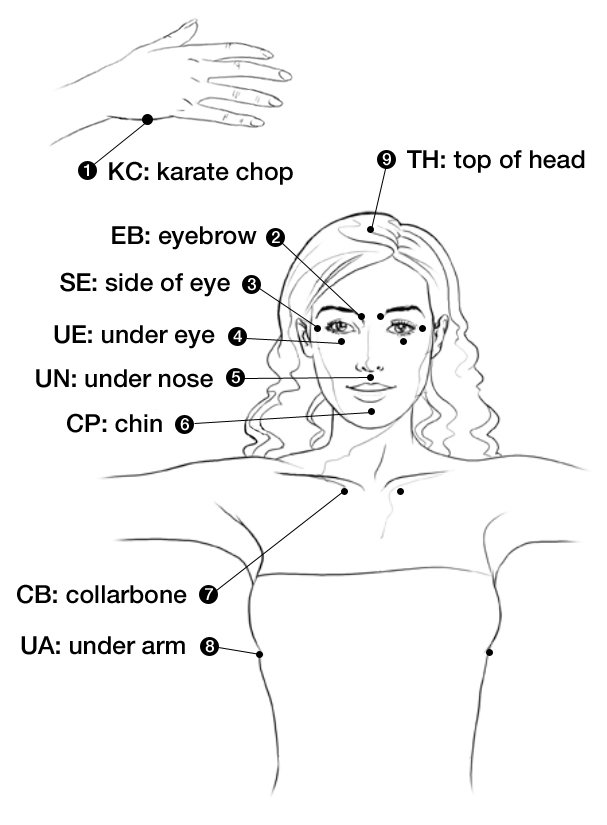
  • Tap the meridian points about 5-7 times while saying the phrase 3 times at each pointTapping Chart & Tapping Points
  • Take a deep breath after each meridian
  • When done rate anxiety again 0-10
  • If higher than 2, can repeat all meridians again if needed.


Crisis Plan (These are numbers for Utah)
EMERGENCY---call 911 or go to the nearest emergency room


TEXT---HOME to 741741 (Can take up to 5 min for responses)


APP---Use the SafeUT app (can chat or make phone call)


PHONE #’s---
Suicide Prevention Hotline (24 hour Crisis Line)
1-800-SUICIDE or 1-800-273-8255
UNI crisis services (24 hour crisis line) 801-587-3000
Warm Line (3 PM-11 PM) 801-587-1055
Weber Human Services (24 hour crisis line) 801-625-3700


Emergency Contacts
Mom phone #
Dad phone #

Other emergency contacts

***************************

Here is the link to a document you can print.
https://docs.google.com/document/d/1lMKnq2wpE0dz0mZ6exhkhzDRBW-X6bnqef4vXGEB0y4/edit?usp=sharing

*******************************

Please like our FB page to see future updates. 
https://www.facebook.com/SupportedInOurTrials/


Wednesday, October 10, 2018

Purchasing 1 mL enfit syringes

I need small 1 mL ENfit syringes.  My local DME does not carry them.  Amazon does not carry them.  Here are several options I have been looking into.

I can get them from my local Children's Hopsital outpatient pharmacy for $0.50 each.

Health Care Logistics = (800) 848-1633 or https://gohcl.com/ 
If you type 19798 in the search bar they will come up.  They come in a package of 100 for $23.50 plus $1.67 tax plus $15.00 shipping (from Ohio to Utah).  So 40.17 for the package of $100.  They are sterile, the non-sterile kind are actually more expensive.  To order you need to call them and get an account set up, then you can order online.  Or checkout as "guest".  They do not provide you with shipping amount at time of checkout.  You have to put in a comment that you want them to contact you with a shipping quote before shipping.

Edgepark Medical 1-800-321-0591 ask for Vesco medical item # VED-601EO.  This company carries them, but they are MUCH more expensive.  $73.20 (incl free shipping) for qty 100.

https://www.medidose.com/ENFitEnteralPharmacySyringes-MetricOnly100Syringes.aspx
has qty 500 for $138.04


Wednesday, September 5, 2018

Adding a hitch to your adapted minivan

We have an adapted minivan (Dodge Grand Caravan with a Braun Entervan side-entrance lowered floor conversion) and one thing we noticed when we bought it is that it had no hitch and we weren't sure if we could add a hitch.  They completely rework the underside of the van in order to lower the floor.  For example, there is a gas tank at the back of the van.

I called Mobility Solutions in Salt Lake City Utah and asked them if they could add a hitch.  They said they don't do that, but referred me to GT Welding to do a custom hitch.

How much does it cost to modify a van for a wheelchair?

Phone estimates on 2 different styles of van modifications to give you a general idea.  The approximate quotes include parts and labor.  Phone estimates gotten from Mobility Solutions in Salt Lake City Utah in July 2018.

Full size van with lift $7,500
Tiedowns $2,000

Braun Entervan conversion on minivan with lowered floor, side-entry ramp (not in-floor) and tie-downs $26,000

Saturday, July 14, 2018

What to look for in an Adapted Van (Wheelchair Van)/ Understanding adapted Van Terminology


Navigating the world of purchasing a wheelchair accessible van can be confusing, overwhelming and expensive...haha.  I will attempt to break down some of the terms that people use and some of the things I think are best to look for in purchasing a van.

When a van is modified (changed) to be wheelchair accessible it is called "modified" or  "adapted" or "converted" or "accessible" or "wheelchair accessible".

I am only covering the topic of staying in your wheelchair to travel...there are other options if you are able to get out of your wheelchair and into a vehicle seat.

Minivans typically have ramps and full size vans have lifts.

The 2 most common brands of lifts/ramps are Braun and Ricon.  Braun is typically used in minivans.  Ricon is typically used in commercial applications (like public transportation) and full size vans.

A ramp is at a 45 degree angle coming out the side or rear of the van.  Here is an example of a ramp.


A lift comes out of the van and stops parallel to the ground.  It then lowers to the ground.  The person then gets on the lift and is raised up to the level of the van floor.  Kind of like an elevator.  Here is an example of a lift.

An "in-floor" ramp means that the ramp gets stored in the floor of the van.  The advantage to this is that when the ramp is stowed (put away, ready to drive) it is not blocking ANY of the doorways.  A "fold-out" ramp will block a doorway.  An in-floor ramp is preferred, but probably less common.  I am assuming it costs more. Here is an example of both.
This ramp will block the doorway
They do have Manual Ramps.  They do not use any electricity.  It is best if the wheelchair user always has a companion helping them.  All electric/hydrolic lifts and ramps need repairs and maintenance every few years (2-3 years in my experience).  I have not had a manual lift, but I imagine it would not need NEARLY the maintenance and repairs of electric/hydrolic lifts and ramps.  I have had multiple times that my daughter has been stuck in or out of the van due to an electrical or mechanical failure on our lift.  I have had to use the manual over-ride.  Manual ramps are much cheaper.  Manual Ramps are also much faster.  Lifts and ramps take a while to get into position.  If I had a choice, I would choose a manual ramp over an electrical one.  Manual ramps are much harder to find on used vehicles.  Here is an example.
Manual Ramp

A lift can be solid or a "split-gate".  (remember lifts are on commercial and full size-vans).  A solid lift will block one of the doorways when it is "stowed" (put away, ready to drive).  A split gate will split in 2 when it is stowed so you can still use the doorway.  It is awkward, but still leaves an opening.  If possible I like split-gate better, that way kids or things can still get in and out through the door.  Split-gate are much harder to find.  You can tell that they are split gate because you can see that the lift is split into 2 halves.  Here is an example of both.
Splitgate LIFT parallel to ground
Split-gate LIFT in "stowed" position

Split-Gate LIFT on ground


Solid LIFT blocks doorway

Solid LIFT blocks doorway
Lifts and ramps can be Rear-Entry or Side entry. The advantage to rear-entry is that you can use ANY parking spot, not just ones with the yellow striped lines next to the vehicle.  Another advantage to rear entry is that the wheelchair does not have to turn to face forward once it is inside the vehicle.  A disadvantage to rear entry is that the wheelchair user has to be #1)way in the back of the vehicle, or #2)there can be no other seats (or a lot of missing seats) or #3)the seats have to fold up.  If you choose fold up seats, that makes it difficult for carseats.  And fold-up seats are really rare.  Here are some examples.

Rear-entry Ramp

Side-entry ramp
Rear Entry Ramp with fold-up seats

Side-Entry Lift

Rear-entry lift

When looking at lifts and ramps, look at backup plans.  How do you over-ride the lift to use it manually if there is loss of power or mechanical failure.

Braunability, AMS(Adaptive Mobility Solutions), Entervan, Activan, VMI (Vantage Mobility International) are all systems that companies have designed.  Basically your local adaptive van place goes to these training facilities (Braunability for example) and go to classes to know how to adapt a van correctly.  They then come back to their local adaptive van place and can adapt vans to those standards and can place the label of "Braunability" or "Braun Entervan" on the adapted van.  Things that they learn would be structural safety, best design practices for ease of use for wheelchair users, electrical wiring, how to aesthetically make if look good inside and out.  So if you see any of these terms you know it is a good and safe conversion.  It means the conversion was done by someone who had specific training.

Tie-downs consist of 3 parts.  Anchors (usually 4) in the van.  Tie-down's on the wheelchair itself (usually 4).  Straps that connect the van tie-downs to the wheelchair tie-downs.  All three of these parts are collectively OR individually called tie-downs.  When getting a wheelchair make sure to ask for tie-downs (sometimes called a "transportation option" or "Transportation package".  One popular brand of tie-downs are called Q-straint.  Here are some examples of van tie downs.  Some tie-downs are fixed in 1 location (like the first pic).  Some tie-downs have a track (like pics 2 and 3) and can be adjusted in different locations for different needs. (I prefer the tracks if possible).


Tie-downs can have a housing where the straps are stored.  This would mean they have some type of "retractor".  It might be automatic, semi-automatic or manual. In the first pic below is the semi-automatic retractor.  It is a red button that will pull the excess strap tighter.  In the 2nd pic is a manual tie-down, you have to pull it tighter with your own muscles.

Manual tiedowns are cheapest.  One advantage however to one with a retractor is that it gets the straps all contained and more out of the way.
Semi-automatic Retractor (red button)

Manual tie-downs

If a van comes with hand controls it means the van can be completely driven without your legs or feet.  You can do the brakes and gas and steering all with your arms/hands.
Hand Controls

Hand Controls

There are many configurations of van seating.  Where do you want the wheelchair user to sit inside the van?  Are they the driver?  or front passenger seat?  or rear of van?   or right behind driver?  Window shop at adaptive mobility shops to see different configurations and go look at some vans for sale near you to figure your ideal configuration out.  Here are some examples.


When shopping for adapted vans, consider full-size vans vs mini-vans.  A full size van can be anywhere from 7-15 passenger.  It is larger than a mini-van.  It would be like a Ford e-series (Ford e350 for example) or a Dodge Ram or a Dodge Sprinter or a Mercedes Sprinter or a Nissan NV etc...  Toyota and Honda do not make a full-size van.
Full-Size Van

Mini-van

Advantages to a full-size van are #1) you can fit more people #2) more room around the wheelchair to do the tie-downs #3) more room around each passenger #4) if it has a raised roof you can stand upright inside the van  #5) more cargo space #6) not required to raise the roof or lower the floor like a minivan #7) modifications are often cheaper if you choose not to raise the roof or lower the floor.

Advantages to minivan #1) A lot more on the market (easier to find) (unadapted mini-vans) #2) easier to drive and park and reverse #3) usually have a sliding door on each side, so kids aren't banging cars next to the vehicle with the door and if you block 1 doorway with a ramp, you have a door on the other side.

In order to make a minivan accessible they almost always need to have a lowered floor or a raised roof.  Usually people opt for a lowered floor.  A lowered floor (from the outside of the van) aesthetically looks more like a normal mini-van.  Making the lowered floor or the raised roof is really pricey.
After-market raised roof on full-size van

After-market raised roof on mini-van
Lowered floor on mini-van with rear-entry

Lowered floor on mini-van with side entry
(notice the sliding door and whole side of van is lowered in addition to floor inside)

Lowered Floor

Although full-size vans do not have to have a raised roof or a lowered floor, several full size vans come with a raised roof from the factory such as the Sprinters (Sprinters come in 3 roof heights), Ford Transit (not Transit Connect, they are short in length like a minivan), some newer Dodge Ram's.  The raised roof from the factory is often called a "high top" or "high roof".  The advantage to a raised roof  is being able to stand up inside the van.  If I need to move my child from her wheelchair to a bench to change her, it is much much much better on my back if I can stand up straight rather than carrying her while hunched over.
Sprinter has a raised roof (high top) from the factory

The majority of people I know have bought their adapted vans on ebay.  Yes,  you buy them sight unseen and yes you have to drive or fly to bring them home or pay to have them shipped.  But you have a much bigger selection and can get better prices.  It is also a great way to compare prices of similar vehicles.  Because you cannot look up adapted vehicles on Kelly Blue Book unfortunately.  I personally only look at the "buy-it-now prices".  You may be able to get a van cheaper through the auction, but it is too much for me.

To do an ebay search I will typically
#1) put into the ebay search bar "wheelchair van ramp" or "wheelchair van lift".  If there is a make I want I will add that also.  Such as "Honda wheelchair van ramp".
#2)Once the search comes up I will select "Buy it now".
#3)Then I will select "sort" and choose "Price + Shipping:  Lowest first"

*******************
Here is another blogpost I wrote about how to pay for a modified vehicle.
http://supportedinourtrials.blogspot.com/2016/05/paying-for-wheelchair-modified.html

*******************
What did I miss?  What advice do you have for people looking for an adapted van?  Please like my FB page to see future posts https://www.facebook.com/SupportedInOurTrials/